


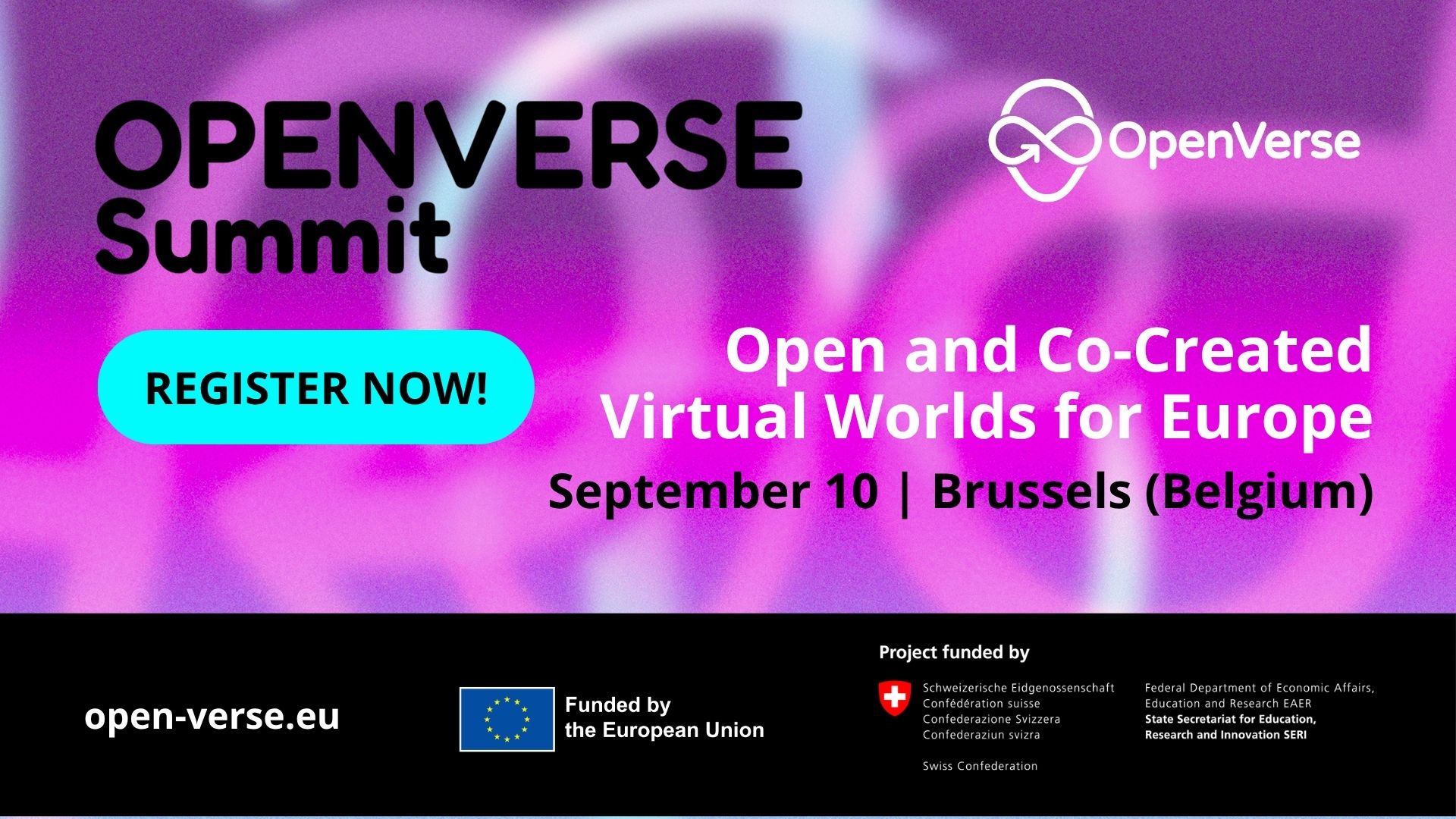
With Virtual Worlds rapidly evolving into critical infrastructure for Europe’s digital future, the highly anticipated OPENVERSE Summit “Open and Co-Created Virtual Worlds for Europe” is set to take place in Brussels on Thursday, 10 September 2026. Marking the culmination of almost three years of intensive collaborative effort, this landmark event which also marks the final event for the OPENVERSE project will bring together leading industry experts, researchers, and policymakers to map out a unified, secure, and human-centric roadmap for Europe’s Web 4.0 and Virtual Worlds ecosystem.
The summit arrives at a critical juncture for the industry. Recent data reveals that European virtual world adoption is accelerating, with 20% of organisations already utilising virtual worlds in 2024. Driven by demands for cost efficiency (38%) and enhanced cybersecurity (29%), this momentum is supported by a massive €400M+ EU commitment, consisting of €200M in Horizon Europe funding (2025-2027) matched by at least €200M from industry partners. However, key hurdles remain – namely high deployment costs (34%), severe skills shortages (30%), and privacy concerns (28%) – all of which the OPENVERSE assets aim to address. Attendees can look forward to a deep dive into the project’s strategic, technical, and regulatory findings across several high-impact sessions.
The Summit will open with highly anticipated welcome and keynote messages from Francesco Mureddu, OPENVERSE Coordinator at The Lisbon Council, and Anne Bajart, Deputy Head of Unit at the European Commission. Their contributions will set the stage for the discussions ahead, offering valuable insights into the EU’s strategy for virtual worlds – both present and future – and OPENVERSE’s vision for human-centric and sovereign virtual environments.
Session 1: Defining the Roadmap for 2030–2040 (10:30 – 11:30)
The summit opens with “Future Scenarios and Roadmap for Open and Co-Created Virtual Worlds at Horizon 2030–2040,” a session dedicated to discussing policy recommendations and technological foresight. Moderated by Gianluca Misuraca, the panel will feature Pierre Rossel introducing the newly designed OPENVERSE Roadmap.
The session serves as a crucial feedback loop to shape the final Roadmap, scheduled for publication in October 2026, which will feed directly into the European Commission’s upcoming Virtual World Partnership. Key industry leaders will debate critical ecosystem challenges:
- Camille Donegan (CEO, Eirmersive) will address the commercial implementation gap, outlining how European SMEs can scale immersive prototypes across borders.
- Patricia Pons Tomás (ITI Valencia) will discuss making trust, safety, and human-centricity operational, specifically addressing urgent modern issues like agentic AI accountability and technological sovereignty.
- Kathrine Fremming (Khora) will offer insights from the studio floor on defeating “pilot fatigue” by developing reusable and transferable digital demonstrators.
- Matthieu Worm (Virtual Worlds Association / Siemens) will discuss aligning VWA priorities with the roadmap, emphasising industrial digital twins as a powerful near-term growth engine.
Session 2: Bridging the Standardisation Gap (11:45 – 12:30)
As interoperability and accessibility become essential enablers of virtual worlds, Session 2 will present a formal showcase of OPENVERSE’s standardisation assets. Moderated by John Favaro, this session will highlight how to unify an incredibly interdisciplinary landscape and overcome Standards Development Organisation (SDO) shortfalls.
Key showcases and discussions include:
- Alina Kadlubsky will showcase the S.E.E. framework (Synthetic Presence and Ethics in AI/XR), which intersects social sciences with technology by synthesizing outcomes from three prominent Horizon-funded projects: XR4HUMAN, SHARE SPACES, and THEIA XR.
- Luis Bravo Martins (XRSI Europe) will share insights on the urgent need for safety and advertising standards via the newly formed Raise Council.
- The panel will also explore sustainability and links to other critical digital initiatives, including the HSBooster and ongoing outreach to the 6G and 3GPP communities.
- Christoph Runde (Virtual Worlds Association) will present an expanded standards landscape mapping and discuss the newly established StandICT Technical Working Group (TWG) on Virtual Worlds.
Session 3: Exploiting the Legacy and Assets of OPENVERSE (14:00 – 15:00)
Later in the day, a dedicated session led by consortium partners of the OPENVERSE project moderated by partner Lapo Fioretti (IDC), this session will focus on the mature, exploitable assets that OPENVERSE leaves as a legacy to the European ecosystem. Key assets to be showcased include:
- John Favaro (Trust-IT Services) will talk about the OPENVERSE Observatory: A rapidly growing community directory that has already registered over 300 entries (expanding to over 400 in recent slide projections) including 250+ companies, 100+ national initiatives, and 30 virtual worlds. It serves as a live matchmaking platform with over 75 conversations started since February 2026.
- Iliaria Mariani (Politecnico di Milano – Department of design) will unveil the Co-Creation Methodology & Handbook: A Double Diamond-aligned co-design toolkit containing 48 curated tools hosted on the project’s Wiki. The accompanying Handbook outlines 6 operational phases to guide moderators through setting up, executing, and sustaining immersive co-creation.
- Francesco Panella (Martel Innovate) will explain how OPENVERSE developed the Collective Intelligence Wiki (wiki.open-verse.eu): A centralised hub consolidating EU-funded virtual worlds research, software components, datasets, and innovation agendas.
- Lukasz Porwol (University of Galway) will discuss the technological framework and the “RAG Model for Governance & IPR”: An advanced, AI-powered knowledge graph. This tool enables stakeholders to conduct context-aware querying of complex socio-legal and regulatory frameworks, including the GDPR, DSA, DGA, and the AI Act.
Session 4: The Role of SMEs in Shaping Open, Sovereign Virtual Worlds,(15:15 – 16:00)
Moderated by consortium partner Michael Barngrover (XR4Europe).
Recognising SMEs as key innovation drivers within open and sovereign Virtual World ecosystems, this session will feature an introductory presentation by a consortium partner, followed by an interactive panel discussion with
- Sébastien Nahon (XR Wallonia)
- Alexandra Gerard (UnitedXR Europe)
- Tim van Dam (Changefied)
- David Lähner (Mindport)
Together with the audience, the panel will examine the unique opportunities, challenges, and contributions of SMEs in building interoperable and sustainable virtual environments, aiming to deliver concrete, SME-led strategic recommendations to strengthen the wider European ecosystem.
Session 5: Sustainable Innovation in Virtual Worlds (16:00 – 16:45)
Thi session will address environmental and operational sustainability as a core strategic priority. Moderated by Lukasz Porwol (University of Galway, Insight Centre), the session builds directly on the project’s D2.3 technological foresight findings. Through a series of cross-sector lightning talks, SME representatives including:
- Sonya Seddarasan (XR Crowd),
- Stephan Sorkin (German Association for Virtual Reality)
- Alina Kadlubsky (Open AR Cloud Europe)
Panelists will address how businesses can operate and grow sustainably in virtual worlds. Aimed at policymakers and SMEs alike, the discussion is expected to generate practical sustainability pathways for businesses and provide policy-relevant insights to support green digital transitions.
The Ethical Debate (16:45 – 17:30)
The summit will conclude with a deep dive into the ethical boundaries of virtual environments in the panel “Ethics in Virtual Worlds,” moderated by Arno Laeven (Lisbon Council).
The discussion will challenge the very foundation of current platform designs:
- Sonya Seddarasan (XR Creator) The Closeness of VR: will explore how immersive environments capture bodily movement and attention in ways traditional devices do not, creating deep trust vulnerabilities that are easy to exploit.
- Abdoul Benamer (CEO of i-OASIS) Consent at the Body Level: will share insights from building immersive training environments, highlighting consent boundaries, physical room awareness, and the emerging threat of AI characters harvesting user movement data. Benamer will also highlight France’s ongoing efforts to build a practical ethics labelling framework.
- Pilar Orero (Professor at Universitat Autonoma de Barcelona) Biased Foundations: will discuss how inequalities and biases are baked into data foundations long before a designer makes a single choice, calling for systemic data-level corrections.
A Living Instrument for Europe’s Digital Future
For those looking to build the future of Europe’s open and co-created virtual environments, the OPENVERSE Summit is a must-attend preview of the tools, roadmaps, and networks that will drive the ecosystem forward.
As the OPENVERSE project concludes, its deliverables including the D2.4 Report on Technological Foresight and the upcoming Roadmap v2.0 will transition into living instruments managed through the OPENVERSE Observatory and the co-programmed Virtual Worlds Partnership of the European Commission.
For more information on the summit and to access the current deliverables, visit the event’s page and check out our library.