


The OPENVERSE Summit: “Open and Co-Created Virtual Worlds for Europe”officially wrapped up in Brussels last Thursday, bringing together over 100 participants at ALBERT, a scenic venue offering panoramic views of the city’s iconic monuments to outline the future of European Virtual Worlds. The event featured six thematic sessions and 27 expert speakers, alongside an interactive exhibition area showcasing cutting-edge solutions from project partners and innovative SMEs.
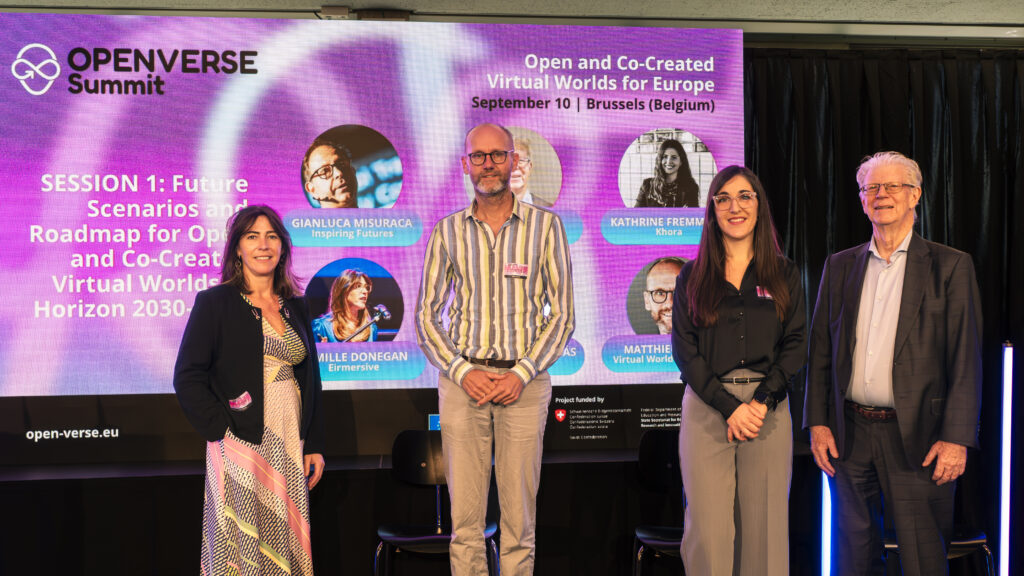 Panel Session 1: Camille Donegan (Eirmersive), Gianluca Misuraca (Inspiring Futures), Matthieu Worm (VWA), Kathrine Fremming (Khora), Patricia Pons Tomas (ITI).
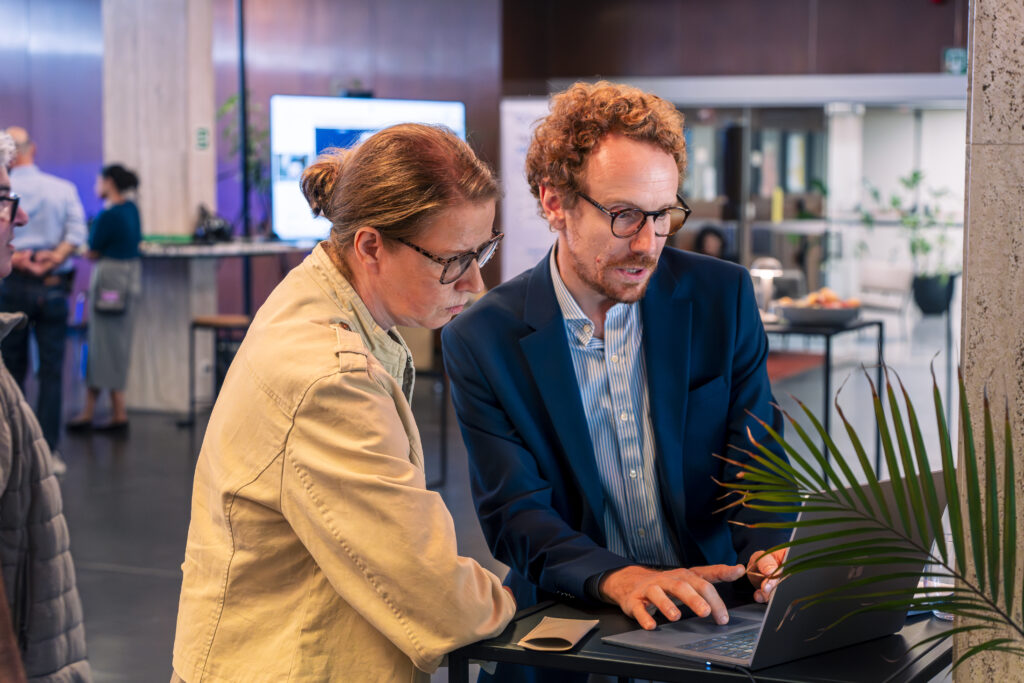 Anne Bajart (European Commission), Francesco Panella (Martel Innovate)
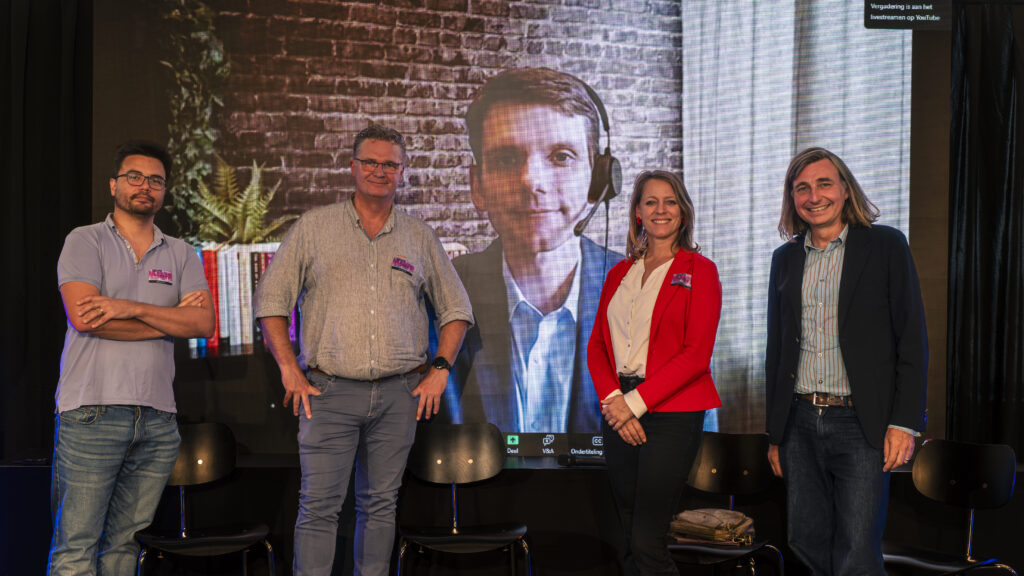 Panel 4: Tim van Dam (Changefied), Alexandra Gerard (UnitedXR Europe), David Lähner (Mindport), Sébastien Nahon (XR Valley)
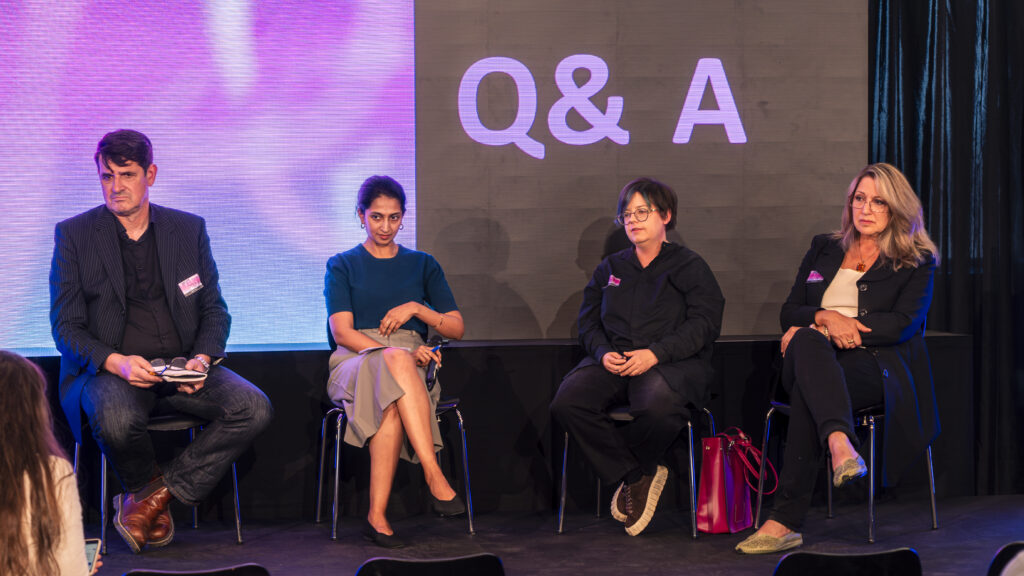 Stephan Sorkin (EDFVR), Sonya Seddarasan (XR Crowd), Alina Kadlubsky (Open AR Cloud), Linda Ricci Jacobs (Independent Designer)
“We need to turn our values into competitive trends. Virtual Worlds need to be open, interoperable, sustainable, secure, and designed for people.”
Anne Bajart, Deputy Head of Unit at the European Commission
Following a welcoming introduction by OPENVERSE Coordinator Francesco Mureddu, Anne Bajart of the European Commission delivered an informal keynote speech. Opting for an open dialogue over a traditional presentation, Anne Bajart highlighted newly established bodies like the Virtual Worlds Association and emphasised the need to translate core European values into competitive industry trends. She stressed that future virtual worlds must be open, interoperable, sustainable, secure, and human-centric, expressing her hope that the Summit would trigger new collaborations across the sector.
Throughout the day, speakers tackled key dimensions of the virtual world ecosystem across six dedicated sessions:
- SESSION 1: Future Scenarios and Roadmap for Open and Co-Created Virtual Worlds at Horizon 2030–2040: Moderated by Gianluca Misuraca (Inspiring Futures), this session explored human-centric technology and how emerging tools can directly serve society. Panelists included Camille Donegan (Eirmersive), Patricia Pons Tomas (ITI), Kathrine Fremming (KHORA), Matthieu Worm (Virtual Worlds Association), and Pierre Rossel (Inspiring Futures). The issues discussed focused mainly on how we can, for example, ensure that good ideas emerging in Europe are put into practice. The experts suggested, in particular, co-creation, co-design and pilots. ‘Usability’ is of great importance. Do people understand the need for usable solutions in Virtual Worlds? How do we solve “real-world problems”?
- SESSION 2: Virtual Worlds standardisation: Chaired by John Favaro (Trust-IT Services) and focusing on standardisation, John Favaro began by explaining that the constantly evolving taxonomy needed to reflect the current findings of the OPENVERSE project. This session was devoted to various aspects of standardisation. Speakers included Luis Bravo Martins (XRSI Europe), Alina Kadlubsky (Open AR Cloud Europe) and Christoph Runde (Virtual Dimension Centre). What new challenges are emerging? How can standards be improved and, for example, manipulation prevented?
- SESSION 3: OPENVERSE legacy: Moderated by Lapo Fioretti (IDC), this session presented the key assets developed within OPENVERSE, detailing the insights behind them and their value to the broader Virtual Worlds ecosystem. Panelists presented their work: Ilaria Mariani (Politecnico di Milano – Department of Design) on the co-creation of the toolkit, Luke Porwol (INS) on the Technological Framework, John Favaro (Trust-IT) on the Virtual Worlds Observatory, and Francesco Panella on the Collective Intelligence Wiki.
- SESSION 4: The Role of SMEs in Shaping Open, Sovereign Virtual Worlds: Moderated by Michael Barngrover, this session focused on the pivotal role of SMEs in shaping Virtual Worlds. Panelists included Alexandra Gérard (UnitedXR Europe), Sébastien Nahon (XR Wallonia), and Tim van Dam (Changefied). Discussion centered on how critical questions such as funding and interoperability, as well as topics around open source and open standards, are tackled at the SME level. Areas that do not always naturally enter everyday business conversations without targeted frameworks like OPENVERSE cultivating the dialogue.
- SESSION 5: Sustainable Innovation in Virtual Worlds: Moderated by Lukasz Porwol (INS), who opened with a call to address the “elephant in the room”. The reality that XR is currently navigating a period of strain and crisis. Despite billions invested and massive progress in technological frameworks and standards, fragile business models continue to lead to platform shutdowns. Panelists Alina Kadlubsky (XR4HUMAN/XRSI), Stephan Sorkin (EDFVR), Sonya Seddarasan (XR Crowd), and Linda Ricci Jacobs (independent designer) joined the discussion to analyse what it will take to sustain Virtual Worlds and why certain endeavours fail.
- SESSION 6: Ethical Virtual Worlds: Session 6: Focused on ethical virtual worlds and how to navigate ethics within immersive environments. Moderator Arno Laeven opened by asking the panel what ethics means to them, noting that while today’s landscape is vastly different from the era of Aristotle, one fundamental constant remains: our shared humanity. The session highlighted that ethical questions in virtual domains are ultimately centered on human values and well-being.
Alongside the main stage, attendees explored an immersive exhibition area featuring hands-on demos of OPENVERSE outcomes. European SMEs also showcased targeted applications, including Changefied’s virtual world platform designed for neurodivergent pupils, and Carrarolab’s video showcase of specialised tools built for education and training.
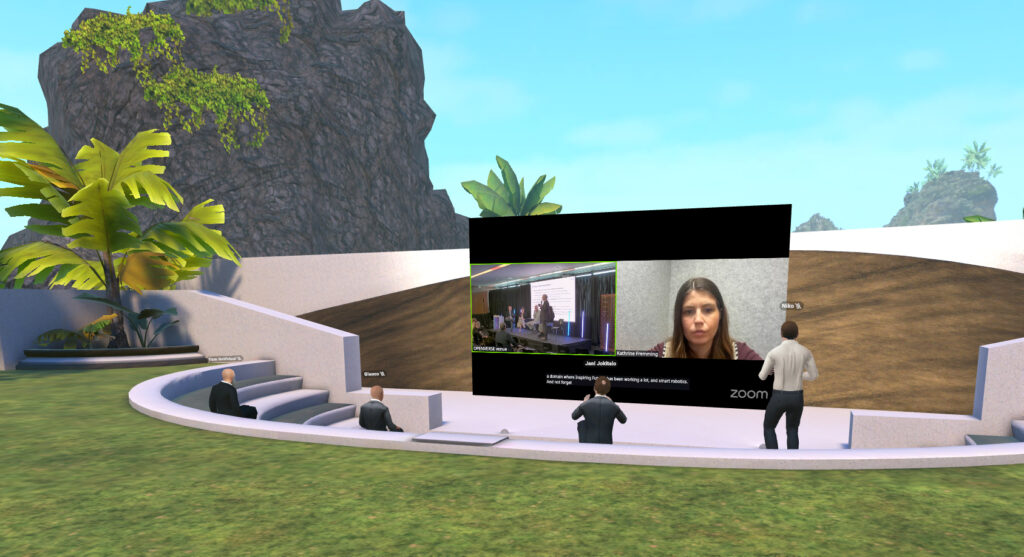
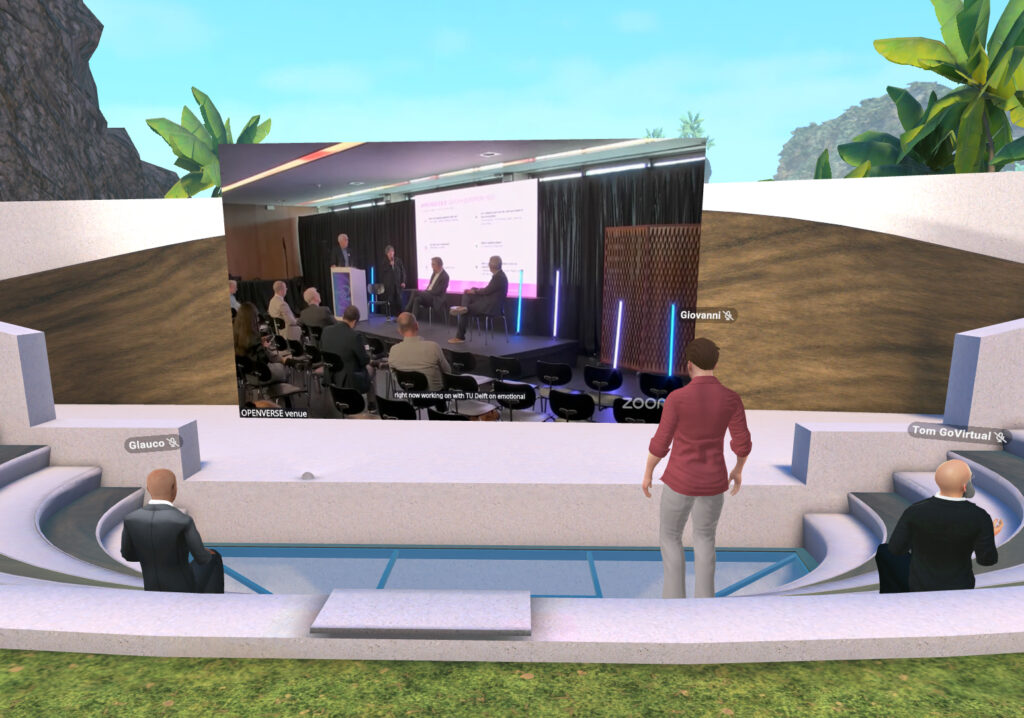
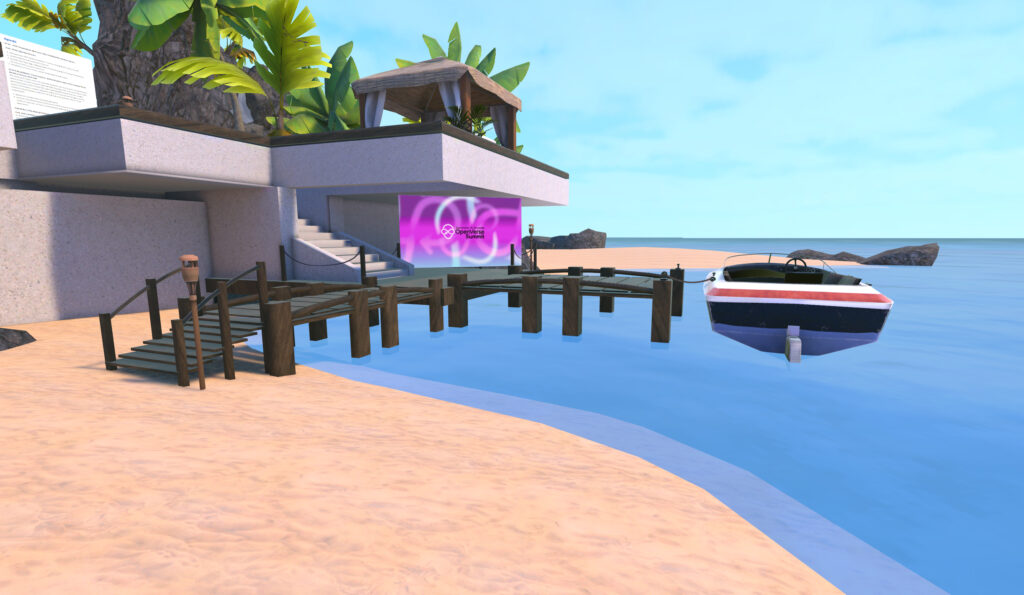
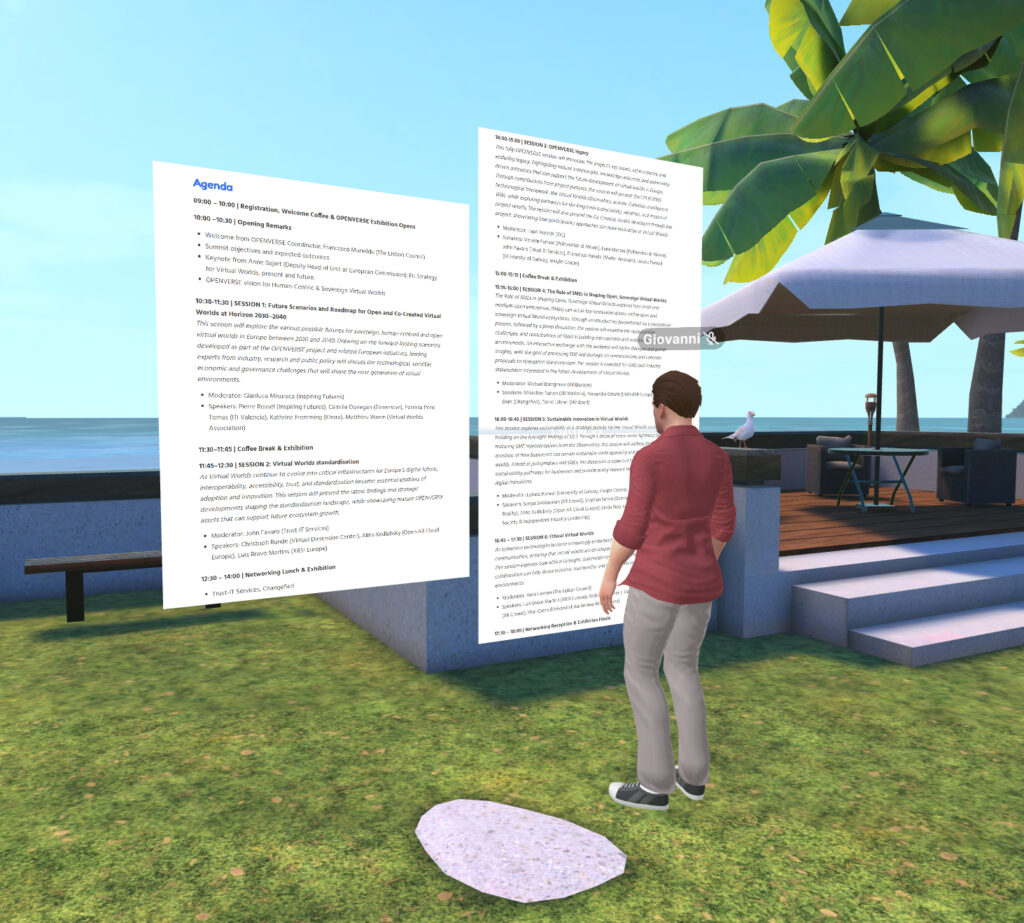
Alongside the physical event, the virtual summit on the ENGAGE VR platform ran smoothly without technical disruptions throughout the day. Set against a virtual tropical island backdrop, the platform featured a live stream of the main stage, enabling remote participants to drop in for specific panels and align their coffee breaks with the Brussels audience. Beyond overcoming organisational travel constraints and broadening European access alongside a parallel Zoom Webinar, ENGAGE facilitated interactive remote engagement. Attendees gathered in the virtual space during breaks and submitted live feedback and questions using an in-world sticky note system, typing or dictating their input directly onto virtual notes displayed around the event agenda.
The summit closed on a high note, leaving participants with fresh insights, new partnerships, and a shared vision for an inclusive European virtual ecosystem. To bring the ethics session and the overall panel discussion to a memorable end, Pilar Orero was asked to give the closing remarks—and responded by singing The Beatles’ “All You Need Is Love” to highlight the human foundation needed for the future of Virtual Worlds.
A full recording of the event is available on OPENVERSE’s official Youtube channel