
It may seem ironic, even counterintuitive, to host in-person workshops when you’re part of an EU-funded project focused on Virtual Worlds like those explored in the OPENVERSE initiative. After all, isn’t the entire point of Virtual Worlds to break down the barriers of distance and physical presence?
Not quite. And here’s why.
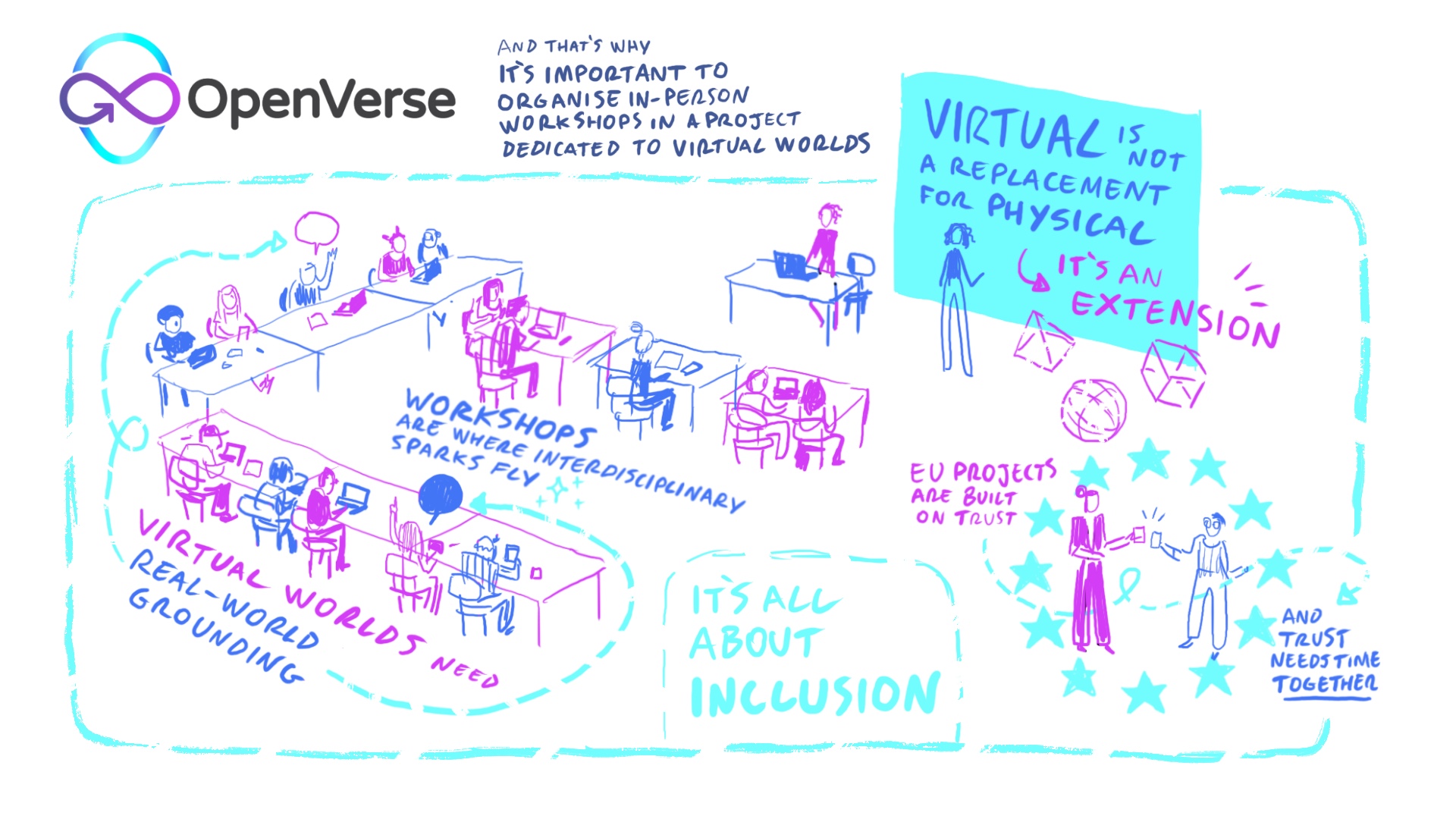
The Virtual Is Not a Replacement for the Physical — It’s an Extension
OPENVERSE, like many ambitious Horizon Europe projects, isn’t just about building technology — it’s about building communities. That means people, relationships, shared values, and co-creation. While digital platforms can host events, simulate environments, and facilitate global collaboration, they cannot yet fully replace the depth and nuance of in-person interaction.
Think of Virtual Worlds not as substitutes for reality, but as layers built on top of it. Just as the telephone didn’t replace conversation, or video calls didn’t end the need for travel, virtual spaces expand what’s possible, but do not eliminate the need for real human connection.
Workshops Are Where Interdisciplinary Sparks Fly
The OPENVERSE project brings together innovators, technologists, artists, policymakers, researchers, and users. In that kind of melting pot, serendipity matters. The casual coffee-break conversations. The whiteboard sketches. The disagreements that turn into new insights. These often don’t emerge in the same way through a screen. In-person workshops create a shared energy that can be hard to replicate virtually, especially across time zones, languages, and cultures. Face-to-face workshops often act as accelerators, building momentum that carries into virtual collaboration later.
EU Projects Are Built on Trust — And Trust Needs Time Together
Anyone who’s worked on a multi-partner EU project knows that trust isn’t a given : it’s earned. And that trust is what allows teams to take creative risks, challenge each other’s assumptions, and ultimately build something that matters. Face-to-face time, even if only once or twice during the project lifecycle, can set the tone for the years of remote work that follow. It turns names on a Zoom grid into collaborators, allies, and sometimes even friends.
Virtual Worlds Need Real-World Grounding
The OPENVERSE project is meant to serve real people, real communities, and real cultural institutions. Organising in-person workshops, especially when they include stakeholders like artists, educators, and policy-makers, Small and Medium-sized Enterprises (SMEs) ensures that the project doesn’t lose touch with reality.
We are building Virtual Worlds for and with people who live in the physical world, and their input is more nuanced and impactful when you meet them where they are.
It’s All About Inclusion, Not Exclusivity
Some may argue that in-person events are exclusionary. That’s a valid concern and one that OPENVERSE takes seriously. Accessibility and inclusion must be baked into every EU-funded effort, especially in digital transformation projects. But the solution isn’t to never meet in person. It’s to be intentional about when and why we meet physically, to ensure those moments serve the broader purpose. Hybrid formats, travel support, rotating locations, all of these can be used to mitigate exclusion while still harnessing the value of face-to-face interaction.
Final Thought: The Best Virtual Worlds Will Be Built by Real People Who’ve Met
OPENVERSE is about imagining and building futures. But those futures are rooted in collaboration, creativity, and shared vision. And sometimes, the best way to imagine new worlds is to step away from the screen, sit around a table, and sketch them out together. So no, it’s not silly to host in-person workshops in a Virtual Worlds project. In fact, it might be one of the smartest decisions you can make.
Let’s build the future of Virtual Worlds together!
Subscribe to the OPENVERSE newsletter, follow us on social media, or drop us a line to stay connected as we build the future of Virtual Worlds — together.